![[Review] Brains: The Mind as Matter – Wellcome Collection exhibition](https://www.futureconscience.com/wp-content/uploads/2012/06/BrainsQR1-125x125.jpg)
 The Wellcome Collection in London have curated some fantastic exhibitions over the years that grapple with the human condition in a way that is accessible whilst still maintaining a great deal of depth and vision. Brains: The Mind as Matter continues the trend and explores ‘what humans have done to brains in the name of medical intervention, scientific enquiry, cultural meaning and technological change’. Not much belongs on Future Conscience more than that, so let’s get into the review.
To begin with, it’s important to recognise that as a free exhibition such endeavours should only ever be commended as the public service that they are – providing enquiring minds with educational outlets that teach, provoke and inspire. It’s the last weekend of the exhibition, and when we visited in the morning it wasn’t too crowded; but I walked by a few hours later and there was a queue around the block to get in. The way in which people were drawn into this exhibition, and the level of engagement that you could see in the people walking around was testament to our fascinating relationship with the subject matter.
Things start getting very meta when you consider that such a configuration consists of the visitor’s brain examining the physical objectification of brains and how they were/are understood within different historical and social frameworks formulated within the brains of the people conducting the work whilst distorted by our individual perceptions of what we are viewing and reading, a strange juxtaposition of the different states of mind that exist throughout time whilst the physical organ itself remains the same – sitting there in a jar gleefully mocking the audience of thousands in some kind of hall-of-mirrors endless recursion into ourselves. Sorry. I won’t do that again.
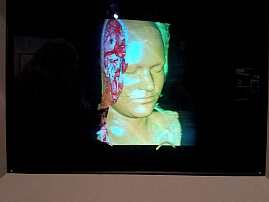
3D holographic representation of a brain scan
What the exhibition mostly consisted of were numerous tools, drawings, models and videos that highlighted our attempts to understand something so complex and yet so central to our experience of being that you end up in a wonderfully recursive loop of enquiry that whilst progressing through time also can never really catch up to the sheer natural beauty of the organ itself. Given that this blog focuses extensively on technology, I was also interested in the changing ways that we have tried to examine and manipulate the brain through technological means.
The exhibition showcased everything from macabre looking cranial screw kits (trephines, new word for the day), head calipers for measuring and categorising people according to skull size, a copper coil MRI ‘jedi’ helmet for children, electroconvulsive therapy machines, containers for storing cryogenically frozen brains, through to holographic imagery systems and micron-thick brain slicing/scanning devices. The exhibition didn’t cover (at least not that I saw) the many issues now being discussed in the futurist field about our ability to technologically or artificially reproduce the function of the brain – although this veers more into ‘mind’ territory than the physical brain itself which was the theme of the exhibition.
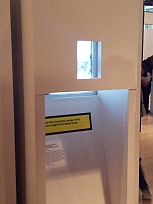
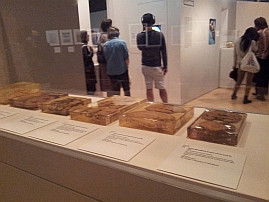
There was an oddly quaint approach to cases of ‘disturbing imagery’ that smacked of a world of political correctness gone mad. Upon walking into the exhibition there was an usher standing at the door whose sole job it was to hand you a little flyer warning you of the possible emotional turmoil you might face at looking at icky things. On top of this were numerous warnings as you make your way in, then you get to the ‘disturbing’ videos themselves and they are placed behind these strange little viewing windows which require you to actively attempt to view them rather than risk the possibility of being disturbed by an accidental viewing (see the image, I’m not sure whether this is a new trend in exhibition design but I’ve never seen something quite so protective).
The exhibition itself also seemed to be lacking some narrative cohesion, and the way in which the various elements were split into different categories (measuring/classifying, mapping/modelling, cutting/treating etc.) meant that it regressed into the more traditional collection of objects with small amounts of interpretative text alongside each rather than building a more contemplative approach to the subject matter that could have been much more directly thought-provoking. There was a good mix of different approaches to the object of the brain, from the artistic to the scientific with a dose of cultural in there when it came to the subject of donating or experimenting upon the brain. There was just something about the exhibition design which left it all feeling less cohesive then it could have been, although once again the Wellcome Collection must be commended for the quality and breadth of the objects on display.
I came away from the exhibition fascinated by the acceleration in our approach to understanding and interacting with our crown organ. The exponential curve of technology that is well understood within the futurist community was here on stark display, and yet amongst it all we didn’t seem to be much closer to breaking through the elusive boundary that separates physical enquiry and objective classification from the experience of consciousness and its capacity for infinite incarnations. The exhibition removed itself from this discussion by focusing on the physicality of the brain, and yet it existed as a spectre running throughout everything – something displayed quite strongly in the artistic pieces and even the vintage film posters. The inquisitive nature of the brain trying to objectively grasp itself is a wonderfully paradoxical aspect of the human condition that matches the depths of theological and philosophical paradox, themselves an inextricably linked component of the whole process.
 Objective and subjective, physical and metaphysical, scientific and artistic, division and unity; all of these working around one another in a more dynamic and fluid form then we are able to appreciate when examining life through individual lenses that are themselves at every moment acting out the miracle of the micro within the macro. It’s hard not to find yourself going down such contemplative paths when literally confronted with the physicality of the organ that allows us to think and be. For this alone the latest exhibition from the Wellcome Collection is a resounding success, another feather in their very illustrious cap. I look forward to seeing what they bring us next.
A quick note of appreciation (or possibly apology) for the photos taken of the exhibition displayed here. If anybody from the Wellcome Collection is reading this, I did buy a copy of your exhibition book as compensation for my clandestine photography. It’s a great book, and I suggest others who didn’t get a chance to visit pick it up as well.