
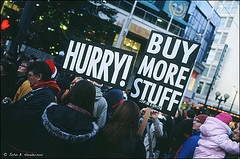
 The circus has rolled through town once again. Scenes of mayhem are a staple of the Black Friday media scrum. For over a decade the consumerist holiday has been pushing its roots down into the depths of our collective psyche and this year, although not the worst in terms of violent outbursts, sees the sinister influence spread internationally with the UK and Brazil readily embroiled in the manufactured hysteria.
Much has been said, and indeed is self-evident, of the contrived nature of the ‘holiday’. Many of the products on sale are sub-par versions of desired luxury items, and the need to inject a sense of urgency into proceedings puts the priorities of retailers well above the benefit, comfort and even safety of their customers. In the US, the scenes of panicked shopping are a stark reminder that the thankfulness expressed just a single day earlier sits on very shaky ground – whilst in the UK and elsewhere the successful attempt to export the furore comes with a hefty dose of dissonance as the time of year isn’t attached to any kind of annual public holiday.
There are a number of things that sit with particular unease about Black Friday. On the outset, the scenes of violence repulse us. How could people behave in that manner? Such savagery, all for a cheap television! Dig a little bit deeper though and you see that most of us are complicit in the feeding frenzy. Over US$57,000,000,000 was spent last year in the United States, and if you didn’t physically enter a store it’s likely that you got caught up with a few online deals (I certainly did). Most of us take part, even whilst speaking of the evils of such blatant materialism. We claim to despise the scenes of violence but are drawn to them likes moths to a flame – the voyeurism and sense of self-righteous indignation validating our closely held notions that the problems faced by society are always manifest in the actions of somebody other than ourselves.
Beyond the more visceral scenes of interpersonal conflict, though, lies a far more sinister narrative. We are quick to blame the people involved on the ground, highlighting a worrying subtext of classist denigration aimed at the poorer demographics in society, whilst the manipulative structures of psychological coercion that rest just underneath the surface are often overlooked as ‘business as usual’. The deeply impacting construction of consumer desire put into motion by commercially vested interests has become so common place – advertising and media sensationalism such an accepted part of our modern identity – that we are primed to miss the forest for the trees.
By focusing on the visual outbursts of violence and directing our anger onto the individuals who perpetrate them, we are overlooking the systemic violence inherent in our socioeconomic frameworks. Our global economy is currently geared in a manner that places human dignity at the bottom of the pile, purposefully manufacturing the desire to participate in structures that have little concern for our wellbeing as whole persons and more interest in our transactional agency as economic actors. We should not at all be surprised that such a framework manifests in scenes of shopping stampedes and subsequent injuries, of people fighting over poorly manufactured luxury items, of forever seeking to procure the new and rarely needed rather than appreciate the already owned.
Black Friday is a reminder that we are losing our grasp on a vision of humanity that uplifts the human being in a society that values each of us as more than just our productive output (an arbitrarily defined, private-sector focused notion of productivity at that). Unfortunately, at the same time that we are able to see this effect in many different areas of modern society and the global inequality that it promotes, we are also starting to buy into the idea that the problem lies with the materialism of the individual. That our own complicity in bolstering this consumerist society is the real problem. Until we can all fix our own selfish desires, how can we possibly suggest we should find alternatives to the structures that only exist to serve such a demand?
The ease with which we can place the blame at our own feet (and credit cards) speaks volumes as to the totality of the indoctrination process. Rather than limit the production of over-supplied goods, we have been coerced into desiring the purchase of them regardless of actual need. For the better part of the last century, our desire for commercial products and consumer luxuries has been consciously shaped to meet an ever-increasing need to match our misconstrued notion that economic growth is the measure of a healthy society.
This casts a menacing shadow over our future. The innovation available through the organising mechanisms of the private sector is immense, and in many instances will be required to weather the coming storms of environmental and geopolitical instability. However, we must break free of the idea that society is dependent on a forever growing economy measured by commercial productivity. Otherwise we will not be able to rectify hierarchical imbalances of authority and agency that have placed the role of the person and our collective wellbeing at the bottom of the priority list. If we continue to put our efforts into constructing the person as servant to an amorphous and insatiable entity know as ‘the economy’, then we are relegating our future to the workhouse by encouraging the dehumanising tendencies of increasingly abstracted institutions.
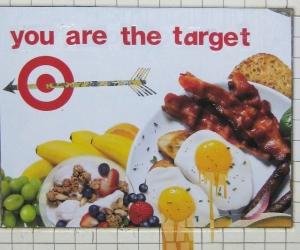 Black Friday should be a forceful reminder that we need to reformulate the purpose of our social, political and commercial institutions in a manner that understands the totality of the impact they have on our collective identity and vision of humanity. It’s time to right the balance, and challenge structures that overwhelm us in the relentless and almost uncontrollable pursuit for the construction of the perfect consumer.
The fact that we are ‘complicit’ in this system, that we profit from it and are kept sated by the products we crave, should not hold us back from seeing the structural violence that lies at its core.
In the words of Oscar Wilde: “…the worst slave-owners were those who were kind to their slaves, and so prevented the horror of the system being realised by those who suffered from it.”