
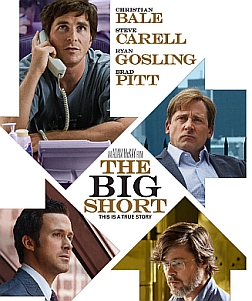
 It’s interesting to consider that we might see this year’s Oscar for Best Picture go to a film about the corrupt underpinnings of the financial sector. Three years after The Wolf of Wall Street was pipped at the post, and nigh on three decades since Wall Street gave us the personification of capitalist greed as Best Actor, The Big Short is capturing people’s attention – not to mention raising our sense of injustice to renewed heights – and acts as a potent reminder that, behind the numbers, there are real people who suffered.
The fragility of the global economy continues to highlight the precarious position we remain in, almost a decade since the financial sector drove economic growth to a crashing halt. Attention spans are short and public sentiment has moved on, which is why a popular film that highlights some of the widespread fraud that ran throughout the global financial system is a useful reminder at an important time. New energy is needed to see through long-lasting reform, momentum for which is dissipating as focuses shift onto issues of migration and international conflict. The Big Short thus comes at a pivotal time, highlighting the systemic abuses that lay behind the financial crisis and our collective ability to eventually find a way to blame (as the film itself states) migrants and the poor for the majority of our social ills.
The timing of the film (and content of the 2010 book it is based upon), with its novel attempts at imparting financial literacy alongside justified indignation, hits an almost perfect moment that will hopefully restore the issues at its core to the forefront of public discourse. A more comprehensive debate on what we really want our financial system to do, and how it should be structured to achieve such goals, is still required and we must challenge any notion that the results are a foregone conclusion or already decided. The lobbying power of the financial sector, and the revolving door between finance/government that helps support it, is well known. Given its popularity, this film has the potential to provide millions of attentive viewers with the impetus to continue to press for reform to counteract such vested interests. It could also, interestingly, help decide the future President of the United States, with Democrat candidate Bernie Sanders running a strong anti-Wall Street platform that is resonating with disillusioned voters.
The accepted narrative in many circles is that the financial crisis was caused by short-sightedness and greed, both of which indeed played a significant role. However, the one-two punch of the film explains that the near junk status of highly rated Collateralized Debt Obligations (CDOs) was followed by large institutional banks trying to cover up their positions until they could limit losses (and in some cases, such as that of Goldman Sachs, even profit) from the collapse of the market. The reverberations of these actions continue to be felt by clients, investors, taxpayers, everyday workers and global society as a whole. Ultimately, the common good suffered horribly in the relentless pursuit of money and power by a relatively small but very influential portion of people in the financial system. Whilst the memory of all this begins to fade, the devastation wrought continues to have an impact on those who were left homeless, jobless, and penniless because of the corrupt practices of some of the world’s wealthiest people.
This is the reminder that the film puts starkly before us. Not just of the rotten mess that lay at the heart of the financial crisis, nor the fact that little accountability has been charged to those most responsible, but that real people suffered as a result. It wasn’t just numbers on balance sheets, in many cases people’s lives were left ruined and destroyed. A report in the British Journal of Psychiatry in 2014 estimated that there were at least 10,000 more economic suicides in the EU, Canada and the USA that could be attributed to the financial crisis – reversing a downward trend in the EU, particularly amongst males.
 During one of the film’s most poignant moments, we are reminded that those profiting from shorting the markets mustn’t celebrate the potential for widespread economic collapse because, we are told, for every one million jobs lost as a result of such a crisis 40,000 people will die. In 2010, a joint report from the International Monetary Fund and the International Labour Organisation stated that global unemployment increased by more than 30 million – three quarters of this within ‘advanced’ economies – during the Great Recession.
Of course, the financial crisis that began in 2007 wasn’t just the result of one type of financial product. Rather it emerged out of a cavalier culture which had come to define much of the financial sector that had embedded itself into a profit-driven, rent-seeking economy and collided with global economic imbalances, government policy environments, and the indebtedness of many sovereign states. The widespread inability to call out the risks inherent in a rising market, and the refusal to listen to the few who did so, expresses a deep-seated set of damaging behavioural traits that had truly grave consequences. The World Bank estimated in 2009 that between 1.4 to 2.8 million additional infant deaths around the world could occur by 2015 because of ‘sharply slower economic growth resulting from the current financial crisis’. It’s impossible to know how many lives were lost as a direct result of the complicated network of failures that caused, triggered and perpetuated the financial crisis. We just know that it’s too many to accurately count.
This sobering reality reminds us of what is at stake. A popular film with global attention is a valuable step in enhancing financial literacy and unmasking the dangers of financial complexity, particularly when geared towards the profit-taking of a small minority. Understanding the issues enables a strong and vocal push for reform, whilst at the same time such knowledge can be used to help create viable alternatives built upon values-driven foundations.
The Big Short is a perfectly timed reminder that, while the worst of this particular crisis may have passed, we have barely begun to help those who suffered the most. Nor have we yet done enough to create a financial system that won’t lead us down such a path again in the future.
 There are
  This close to a key vote, it’s time to find ways to contact MEPs that will be heard. That’s why I would recommend not merely