
Tag Archives: new scientist

Desertec aims to use the Sahara to harness power

Should Europe harnass the power of the Sahara?

Should Europe harness the power of the Sahara?

An interesting article over on New Scientist today about the Desertec project, a German initiative which looks like it might receive a substantial amount of investment from a conglomerate of corporations.  Projects such as this are a welcome sign, as it means that the need for alternative energy sources is really picking up steam (pun intended).  However, the article also highlights many possible downsides of such a project – with the question being, could it cause more problems then it is worth?

The costs of such a project are huge, running into the hundreds of billions, but nobody denies that such efforts are unnecessary; just that there might be better ways to pursue them.  As it stands, Desertec seems like a project that has more than a small element of wishful thinking surrounding many of the requirements for its successful implementation.  Questions surrounding the exploitation of African countries for European power supply; the more immediate concerns of political stability of the region; and the logistical practicalities of such a monumental undertaking are just some of the criticisms that the project faces.

In the end there will not be a single answer to global energy concerns.  What is needed are a number of avenues for alternative energy that work in tandem with one another, not least of which to ensure that there is no dependence on a particular power source or method of obtaining it.  We also just cannot presume that there will not be social, political, and economic difficulties – which will only be exacerbated when asking for co-operation and sharing of such alternative energy resources over large distances.

Having said this, the Desertec project has the capability to be providing 15% of the power needs for the very large area of Europe by 2050 – an amount that is certainly nothing to scoff at and dismiss without some very serious consideration. Given that the project might soon find some very large backing – to the tune of 400 billion Euros – this could be an experiment that is going to take place regardless of those who would speak against it.

For all of the well-founded criticism surrounding it, projects such as Desertec should be closely considered and, at the very least, recognised as an attempt to solve what could rapidly become the most challenging and pressing problem that humanity faces over the next century. Whether it might prove to be reaching beyond its practical grasp is yet to be seen, but without attempts to try and engender such large-scale solutions we could very quickly find that we have spent so much time debating that nothing is properly implemented in time.

What do you think of the Desertec project?  Are the resources needed to bring it to completion better off spent engineering home-grown solutions to alternative energy supply?  Or is it to be excitedly recommended as a proactive attempt to solve issues surrounding climate change?

[ad name=”Google Adsense-Link Banner x4″]
Down at the pub with Kim Stanley Robinson, Geoff Ryman and Paul McAuley

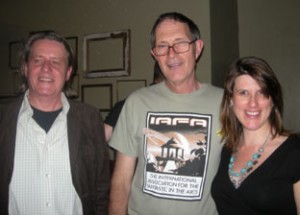
In conjunction with New Scientist’s recent special on science fiction, a pub meetup was held with some of the greatest sci-fi writers of the current era.  This intimate and relaxed setting was an experiment for New Scientist, we were told, and developed out of a somewhat failed attempt at a much larger event – an outcome that I think worked greatly in the favour of all involved.

Geoff Ryman, Paul McAuley and Alison George

Paul McAuley, Geoff Ryman and Alison George

The writers were three of those that participated in the recent issue of New Scientist:  Kim Stanley Robinson (famous for his Mars trilogy), Geoff Ryman (author of Air: Or, Have not Have) and Paul McAuley (The Quiet War).

The meetup was of the kind that London does so well – contrasting the massive metropolis with a small room above a pub filled with people talking about things they love.  At the beginning, there was a feeling of ‘how is this going to work?’; but as more of us began to mingle, and others began to initiate conversation with the authors, the room began to buzz with the chatter and dynamic that only a pub can offer.

The crux of the evening came from readings by each of the authors.  Kim Stanley Robinson read out a recently discovered letter from Virginia Woolf to Olaf Stapledon (author of Star Maker), which showed a side of the almost mythological author that appreciated science fiction greatly.  He used this letter to discuss the changes brought within literature, where it shifted from focusing on the very slow (where descriptions of single events could take up dozens, or even hundreds, of pages) to covering a hundred years or even, in the case of Star Maker, the entire history of the universe.

Paul McAuley followed this with a reading from his most recently published book The Quiet War, which has a sequel coming out in a matter of weeks, and also regaled us with anecdotes of sitting briefly within the original ball chair of Number 1 from The Prisoner – “I don’t see how he could have heard anything from in there – he must have had an early iPhone or something”.

Geoff Ryman concluded the trio with a wonderfully theatrical reading of a short piece that he had recently written.  Sat atop the bar with his legs dangling below, his gestures and rhythmic phrasing made the piece on future life-blogs feel almost like poetry.  A wonderful performance.

Following the reading was some time for Q & A, where many different questions were asked and answered.   A common thread throughout many of the answers was that we are really living science fiction now, that the things previously dreamed of were coming to fruition very quickly.

Early genre staples such as interstellar space travel are being replaced with many different avenues of enquiry – such as biotechnology and the new digital world.  The merit of HG Wells was remarked by all three writers, highlighting again just how many of the plot devices we take for granted now were created by him.

It also provided a great opportunity for yours truly to put out a question about my absolute favourite author, Philip K. Dick, to Kim Stanley Robinson  – who wrote his doctoral thesis on The Novels of Philip K. Dick.  I asked which was his favourite PKD book, and also how he felt that his works had influenced him.

After stating that it is obviously difficult to choose just one of PKD’s excellent books – and listing many of the more famous and well-known ones – he settled upon the relatively unknown Now Wait for Last Year.  The influence that PKD has had on his work is mostly two-fold, and is something he has spoken about in previous interviews.  Mainly, that the characters in PKD’s novels are often just everyday individuals, the little people – a strategy that brings the truth inherent within science fiction out with remarkable efficiency.

He also praised Philip K. Dick for his excellent use of literary structure and the way in which he can utilise different character viewpoints in order to create a more cohesive vision.  By shifting perspective we can see not only what a character thinks of themselves, but also gain insight into how others see them – creating a more realised and immersive world.

[ad name=”Google Adsense-Medium Square”]

The festivities ended with many of us continuing to drink and converse until the pub staff could take no more.  Overall, it was a fantastic evening and Sumit Paul-Choudhury, Alison George and Rowan Hooper (who was tweeting about the event live) from New Scientist should be commended for planning and hosting the event.

It was one of those moments where you just felt that those around you were really striving to make sense of the human condition and where we may be headed.  Obviously, Liz and I are quite partial to such an atmosphere so we really appreciated being able to converse with some truly great thinkers.

Thank you to all the authors involved, and thank you also to the New Scientist team.

[ad name=”Google Adsense-Link Banner x4″]

New Scientist and the return of science fiction

New Scientist today released a great issue, which has a number of pages devoted to the genre of sci-fi overseen by one of the genre’s masters Kim Stanley Robinson.

Continue Reading