Header image by Kyle McDonald, Creative Commons
With billions of views per day and hundreds of hours of video uploaded every minute, independent, searchable and algorithmically personalised video content is the king of modern media. Traditional television channels are becoming irrelevant, newspaper media is losing steam and cutting the cord is the new normal. This video gold rush is creating overnight celebrities – both intentional and accidental – whilst providing a platform for self-expression and political accountability that is changing the world.
This shows us an inspiring range of positive and uplifting examples, whether showcasing people’s talents or acts of kindness; holding to account structures of authority and speaking truth to power; sharing philosophical, spiritual and scientific knowledge and insight; or allowing us to see a wide-variety of viewpoints that help to undermine channels of information control and dissemination. The revolution is being live-streamed.
Yet amongst this outburst of creativity and innovation there’s a darker undercurrent; one highlighting that the drive for recognition and fame has a corrosive character to it, no matter how it is created and presented to us. It begins with a kind of hyper-narcissism, but quickly develops into something more perverse and psychotic that believes more in the power of algorithms and monetisation than it does ethics and communal empathy. Whilst we consume every ounce of content streamed into our lives, personalised into any specific interest, people are literally dying for views as they try desperately to catch hold of online recognition and the millions of followers (and revenue) that comes with it.
Unfortunately, the endless search for views and subscribers is leading many people astray. In recent years there has been a growing list of sadistic, exploitative or even fatal examples of the new celebrity culture gone horribly wrong. From the US woman who fatally shot her boyfriend in front of 30 onlookers “because we want more viewers”; to the live-streaming of suicide, violence and rape that plagues platforms such as Facebook; to examples such as a woman whose first instinct, following the brutal shock of a car accident, was to live-stream her own sister as she lay dying in front of her. There is a whole landscape of content that is terrifying in its callous attitude towards human life and dignity.
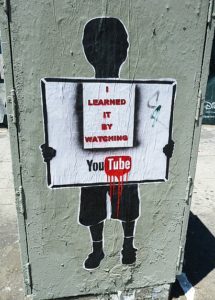 Beyond these examples lies a more perverse layer of disturbing content, often seeing parents exploit their own children for online fame/infamy and ad-revenue. Recent examples of emotional and physical abuse have seen children taken away from their parents, while YouTube begins to crack down on the worrying trend for children’s content that caters towards graphic depictions of gross-out behaviour. It has taken over a year of people speaking up about the inappropriate content being served algorithmically to children (often left unattended by parents in front of the YouTube Kids app) before Alphabet/Google has even begun to react. They had more important things to crack down on, apparently, such as political content and legitimate social debate.
We have stepped through the looking glass and are now confronted with the image of modern society’s soul, beautiful and enchanting but with rotten teeth hidden beneath a wry smile. As we witness the creativity emerge from those who are born digital, with new expectations around privacy, success and entrepreneurial endeavour, it gives us a glimpse into the impact that our endless drive for technological progress is having on how we relate to one-another on a fundamentally human, biological level.
YouTube has a lot of questions to answer about what its loyal content creators have dubbed the AdPocalypse, but what’s more worrying is the canary in the coal mine regarding the impact of algorithms on the creation of culture and social norms. The recent Medium post by James Bridle entitled ‘Something is Wrong on the Internet’ sums it up perfectly as part of a discussion on exploitative, disturbing content for children on YouTube when he says that:
“This is a deeply dark time, in which the structures we have built to sustain ourselves are being used against us — all of us — in systematic and automated ways … What concerns me is that this is just one aspect of a kind of infrastructural violence being done to all of us, all of the time, and we’re still struggling to find a way to even talk about it, to describe its mechanisms and its actions and its effects.”
One of the unintended side-effects of our new reliance on social media and algorithm-led platforms is the erosion of the foundations of culture and its reliance on human-to-human dissemination. By relying instead on algorithms to serve up an echo of taste and preference, an invisible hand that plays the deciding factor in what is popular at any given time, content creators end up trying to serve the algorithms more than a sense of creative and professional integrity. What are we losing when we hand ourselves over to these profit-motivated algorithms, tweaked and experimented upon behind closed doors and opaque corporate strategies?
It is becoming evident that this whole process is centred upon a level of detachment from human emotion and empathy that is more akin to psychotic or sociopathic behaviour than it is a well-adjusted concept of social awareness. Perhaps updated algorithms based upon or led by a more sophisticated form of artificial intelligence could overcome this challenge, but by that stage the echo-chamber of cultural creation will have become so faded and distorted (a copy, of a copy, of an algorithm-chosen copy) that it might be too late. It’s an important warning to take note of. We don’t know where it will lead, but we can already see that it is providing the grounds for disturbing, schizotypal content to emerge.
Even at a more benign level, the revolutionary aspects of these new platforms are being overshadowed by narcissistic personalities, rampant materialism, and an endless need for validation that is unobtainable. Our feeds are filled with people destroying high-value consumer products (surely a symbol of the end-times of capitalism) and conducting mindless stunts for attention, such as cementing their own head into a microwave. We are finding it difficult to incentivise political activism, community involvement and academic excellence over the more base desires of the human condition. Perhaps this is just as it ever has been and these new platforms only serve to highlight a perennial element of our lives. In which case, we should be concerned about the speed at which these less desirable aspects of our identities can grow and spread as they propagate faster and more comprehensively than ever before.
Narcissism now carries around a video camera, filming every aspect of our lives for others to consume and live vicariously through. Just as our governments and for-profit service providers are ruthlessly eroding any right or expectation to privacy and political context in our lives, so are we ourselves gleefully complicit in this shift towards a less nuanced, highly constructed view of what humanity should be striving towards.
It seems that there’s little we can do about this other than to become content creators ourselves. The obvious antidote would be to showcase and harness the power of these platforms for collective good over and above selfish endeavours. Otherwise, we will increasingly rely on forms of censorship as a blunt tool that will be misused and over-extended, becoming a problem in and of itself.
 It’s encouraging to note this creative response is already happening. There are already millions of people creating informative, positive, educational, uplifting content that speaks to the greater aspects of who we are.
Unfortunately though, for whatever combination of reasons, these forms of content are less favoured by the algorithms that serve us a vision of what is ‘most popular’. They are often less palatable to advertisers and corporate gate-keepers who are leading us blindly down a path towards a future where creative vision and innovation are downtrodden underneath a tidal-wave of merchandise touts and self-promoters.
If we can’t overcome this situation only through the addition of desirable content into the system, then there is a great deal of responsibility and agency placed on parents, peer groups and individuals to ensure that we are providing the proper contexts for these new forms of expression to be discussed and responded to. A positive outcome will depend on the level of involvement that people feel motivated to step up to.
By being more involved as content creators and systemic activists, commentators and role models, as leaders providing innovative examples of how to harness the power of technology for the common good, we help society stand firm against the waves of instinct threatening to overcome our better natures. It will also ensure that we are less easily manipulated by those with corrosive, power-driven, profit-seeking agendas. Like many things in life, this kind of contextual education will be key to building a positive future.
Technology holds up a mirror to our collective souls that responds to the images we present and feeds back into the creation of our future selves. By handing this over to algorithms and hollow monetisation we remove the humanity from the equation – which means it is our humanity that we are removing from our future selves that will develop based on its interaction with the content we are consuming today.
Perhaps this can all be put down to changing preferences and trends, a forever revolving tension between old and new throughout the generations. In many instances this will be the case and maybe there’s nothing wrong with watching people go about their day in an entertaining manner. But perhaps there is also something more at stake as we begin to meld our physical and technological selves and blur the boundaries between the two.
If we are laying down the foundations for what we want to be and creating the cultural bedrock for our future morals and sense of humanity, what future are we creating when we are motivated by an obsessive desire for money and recognition? If the image that we are feeding into the technological mirror forms the basis for our future selves, what will we become when we will do anything for the views?
Like, comment and subscribe…